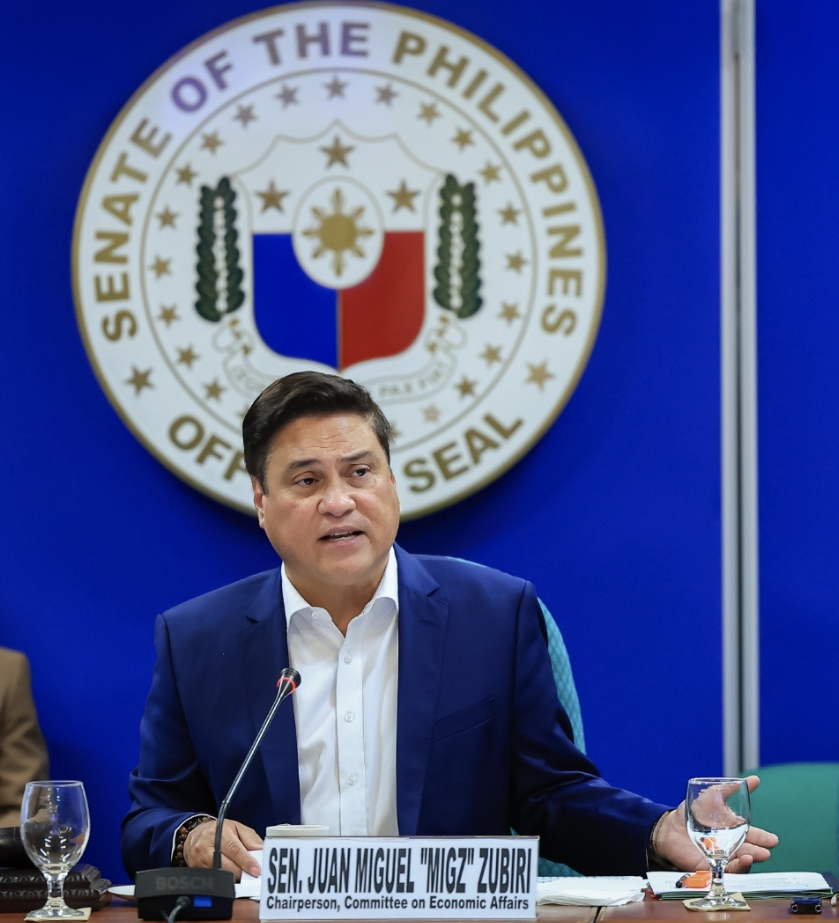
Senate Majority Leader Juan Miguel “Migz” Zubiri recently moved seven international treaties and agreements covering aviation security, space objects liability, taxation, higher education, and criminal justice and law enforcement cooperation a step closer to Senate action.
This followed after the Committee on Foreign Relations completed its hearing and began preparing the corresponding committee reports for approval by its members.
Zubiri, who recently assumed chairmanship of the Senate Committee on Foreign Relations, said he wants to clear the backlog of international agreements affected by recent leadership changes in the chamber, while making sure each measure undergoes sufficient scrutiny before it is brought to the plenary.
“We are not here to simply greenlight them all without ensuring first that the Philippines is always on equal footing with its treaty partners. Walang lamangan, ika nga,” Zubiri stressed.
Among the measures taken up was the Protocol to Amend the Convention on Offences and Certain Other Acts Committed on Board Aircraft, which seeks to strengthen the legal framework for dealing with offenses and unruly behavior aboard international flights by expanding the circumstances under which states may exercise jurisdiction.
The committee also tackled the Convention on International Liability for Damage Caused by Space Objects, which Zubiri said has become increasingly relevant as debris from foreign space launches reaches Philippine territory, with accession giving the country a treaty-based legal framework for claiming compensation should another state’s space activities cause injury or property damage in the Philippines.
On the economic front, the committee considered the Agreement between the Government of the Republic of the Philippines and the Government of the Kingdom of Cambodia for the Elimination of Double Taxation with Respect to Taxes on Income and the Prevention of Tax Evasion and Avoidance, which would establish clearer tax rules for Filipino and Cambodian businesses and investors operating across the two countries and help prevent the same income from being taxed twice.
Zubiri also backed the proposed Agreement between the Manila Economic and Cultural Office in Taiwan and the Taipei Economic and Cultural Office in the Philippines on the Avoidance of Double Taxation and the Prevention of Fiscal Evasion with Respect to Taxes on Income. He explained expanded economic ties can be pursued while fully respecting the Philippines’ One China Policy and without allowing political differences to unnecessarily obstruct legitimate business and investment.
For education, the committee took up the Asia-Pacific Regional Convention on the Recognition of Qualifications in Higher Education, or Tokyo Convention, which seeks to promote fair and transparent recognition of academic qualifications among participating countries and could widen opportunities for Filipino graduates pursuing further studies, professional mobility or employment abroad.
Also discussed were the ASEAN Treaty on Extradition and the Treaty between the Government of the Republic of the Philippines and the Government of the Republic of India on Mutual Legal Assistance in Criminal Matters, which could strengthen the country’s ability to pursue fugitives and transnational criminals, obtain evidence across jurisdictions, trace assets and secure cooperation in criminal investigations and prosecutions.
Zubiri said the committee’s work on the seven measures is seen to build on the Senate’s recent concurrence in the Status of Visiting Forces Agreements with Canada and New Zealand.