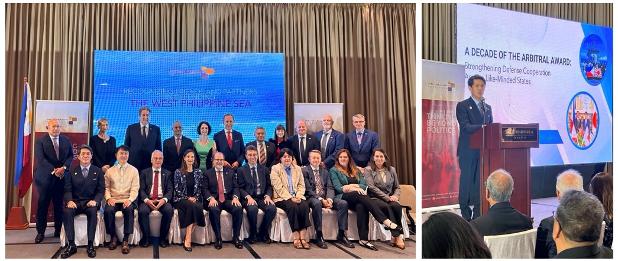
Japanese Ambassador Endo Kazuya recently attended a symposium organized by the Stratbase ADR Institute for Strategic and International Studies (ADRi) to commemorate the 10th Anniversary of the Arbitral Award on the South China Sea.
Ten years have passed since the issuance of the Arbitral Tribunal’s award between the Republic of Philippines and the People’s Republic of China regarding the South China Sea.
The symposium brought together members of the diplomatic corps, government officials, and experts to exchange perspectives on the South China Sea.
In his remarks, Ambassador Endo highlighted the remarkable progress in Japan–Philippines relations, noting that recent high-level engagements, including the State Visit of President Ferdinand R. Marcos Jr. to Japan, have further strengthened the bilateral partnership and ushered security cooperation into a new phase.
In a separate press release, the Embassy of Japan highlighted the five-point statement issued by Foreign Minister Motegi Toshimitsu:
“1. Today, ten years have passed since the issuance of the Arbitral award on the disputes between the Philippines and China regarding the South China Sea. The Arbitral award is final and legally binding on the parties to the dispute, the Philippines and China, under the provisions of the United Nations Convention on the Law of the Sea (UNCLOS). Therefore, the two states are required to comply with the Arbitral award.
2. Japan reaffirms that, as the Arbitral award made clear, there is no legal basis for China’s expansive maritime claims in the South China Sea. The claim by China that it will not accept the Arbitral award is against the principle of peaceful settlement of disputes in accordance with international law, as reflected in UNCLOS, and undermines the rule of law in the international community.
3. Japan highly appreciates the position of the Government of the Philippines, which has consistently complied with the Arbitral award and shown its commitment to the peaceful settlement of disputes in the South China Sea.
4. On the other hand, unilateral attempts to change the status quo by force or coercion, which threaten regional peace and stability, have continued and strengthened in the South China Sea over the past ten years. Japan strongly opposes these attempts and reiterates its serious concern over dangerous actions that threaten the freedom of navigation and overflight, as well as increase regional tensions, including the militarization of disputed features and unilateral establishment of a “Nature Reserve” over it.
5. Based on the strong belief that the free and open international order based on the rule of law benefits all countries, Japan has been expanding maritime cooperation through Official Development Assistance (ODA) and Official Security Assistance (OSA), and strengthening cooperation with defence authorities and coast guard agencies of relevant countries. The issue with regard to the South China Sea is directly related to the peace and stability of the region and constitutes the legitimate concern of the international community as a whole. Japan, as a legitimate stakeholder who uses the South China Sea, will continue to work in coordination with the international community, such as ASEAN Member States and the United States, to maintain and strengthen the free and open international order based on the rule of law.”