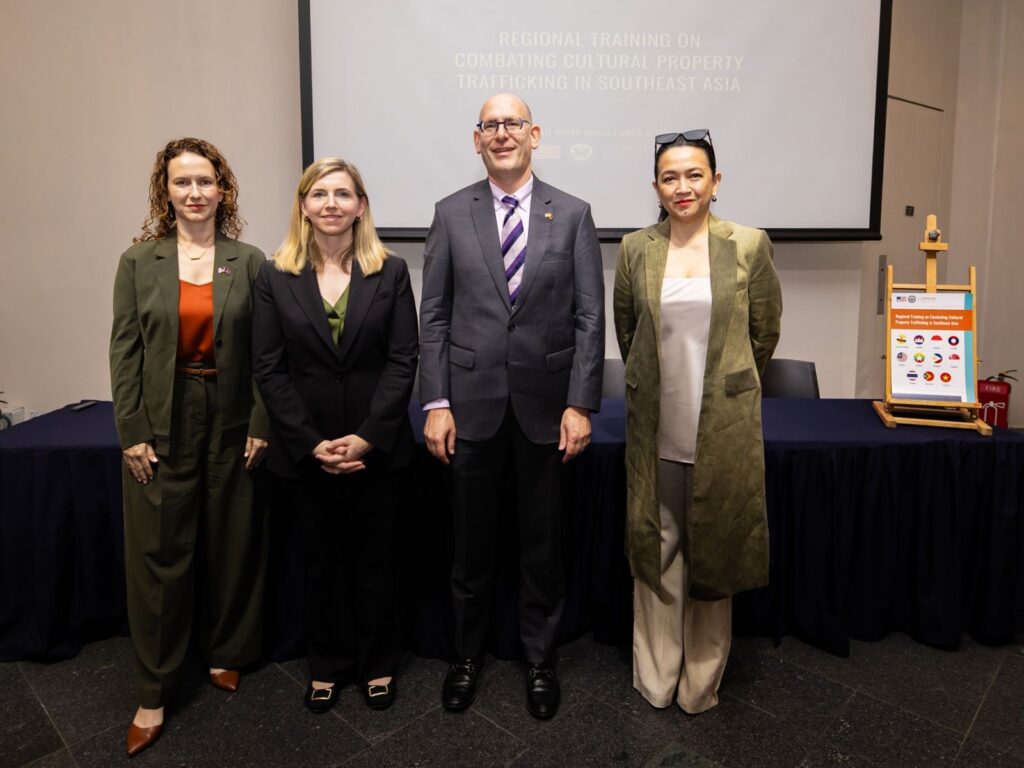
[In photo: (L-R) Antiquities Coalition Executive Director Tess David, U.S. Department of State Cultural Heritage Center Senior Analyst Virginia Herrmann, U.S. Embassy Charge d’Affaires, a.i., Y. Robert Ewing, and International Council on Monuments and Sites Philippines Vice President Dr. Caroline Marie Quinto Lising at the opening ceremony of the “Combating Cultural Property Trafficking in Southeast Asia” regional workshop.]
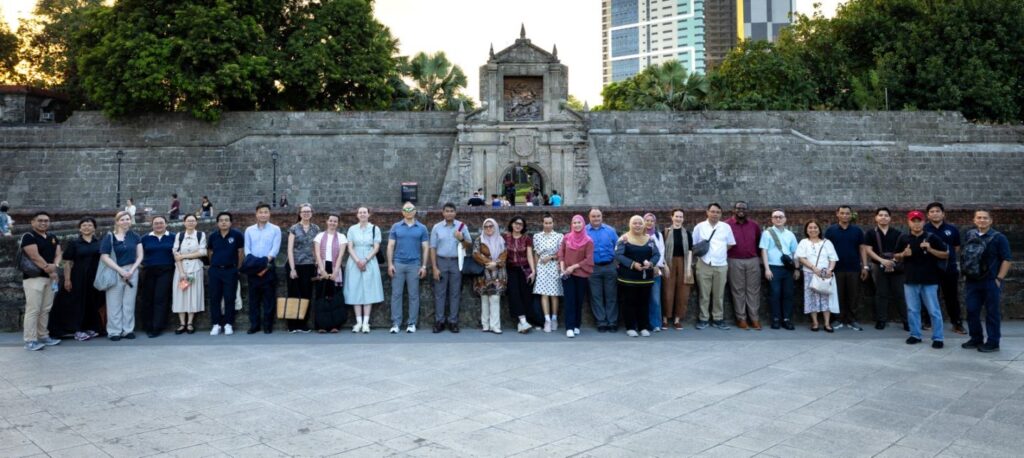
The United States Embassy in the Philippines convened law enforcement officials and cultural heritage specialists from ASEAN member states for the workshop titled “Combating Cultural Property Trafficking in Southeast Asia” held recently at the Ayala Museum in Makati City.
Funded by the U.S. Department of State and hosted in the Philippines during its ASEAN Chair Year, this program strengthens the national security of the United States and ASEAN member states by enhancing regional cooperation to disrupt criminal networks and terrorist organizations that steal and sell artifacts to finance organized crime and criminal activities.
In his opening remarks, U.S. Embassy Chargé d’Affaires, a.i., Y. Robert Ewing said, “When cultural objects are stolen, communities lose part of their history and identity. Cultural property trafficking is closely tied to transnational organized crime, and in some cases, to terrorist financing. Groups like ISIS have used the sale of antiquities to generate revenue, turning cultural heritage into a tool for violence and instability.”
“Strong relationships between investigators, prosecutors, and cultural experts are essential. The United States stands with ASEAN partners in this effort. Together, we can disrupt these networks and protect the cultural heritage that defines this region,” he added.
Throughout the four-day workshop implemented by U.S. non-profit organization Antiquities Coalition, 20 participants from across Southeast Asia learned about the scope and complexity of cultural property trafficking in the region; the links between antiquities trafficking and financial crimes; approaches to strengthen coordination across agencies within their governments; and how to engage international, regional, and national legal instruments that govern the protection of cultural property.
According to Antiquities Coalition Executive Director Tess Davis, cultural trafficking persists due to the art market’s global reach, high value, and weak regulation. “This is not a problem any country can solve alone. This trade harms cultural heritage, local communities, and national economies,” said Davis. “That is why partnership between the United States and ASEAN matters so much. It is fitting that we are gathered in a country whose cultural heritage is among the richest in the region.”
Representatives from the U.S. Department of State, Federal Bureau of Investigation, Customs and Border Protection, and Homeland Security Investigations presented American approaches to investigating and prosecuting cultural property crimes. They highlighted the value of Cultural Property Agreements—bilateral agreements between the United States and partner countries that prevent trafficked artifacts from entering the U.S.
By the end of the workshop, participants examined their respective countries’ cultural heritage protection frameworks and developed a roadmap for sustained cooperation between ASEAN nations, the United States, and other stakeholders to combat the illicit antiquities trade.
This workshop builds on a high-level U.S.-ASEAN meeting on cooperation to combat cultural property trafficking held in Jakarta in April and aligns with U.S. efforts to secure Cultural Property Agreements with countries across the region. The issue spans all three pillars of the ASEAN Community—socio-cultural, economic, and security—making U.S.-ASEAN cooperation essential to safeguarding cultural heritage, protecting tourism and local economies, and strengthening regional security.
According to reports, criminal syndicates and terrorist organizations generate millions of dollars by looting temples, archaeological sites, and museums across the world, then selling stolen objects on the international market to finance terrorist groups and organized crime—the same networks that engage in drug trafficking, money laundering, and armed conflict. U.S. law enforcement has led global efforts in this fight, recovering over 2,500 trafficked items between 2011 and 2023 tied to the Kapoor network and valued at more than USD143 million, and securing the largest-ever forfeiture of USD12 million tied to trafficker Douglas Latchford, whose activities affected countries across Southeast Asia.