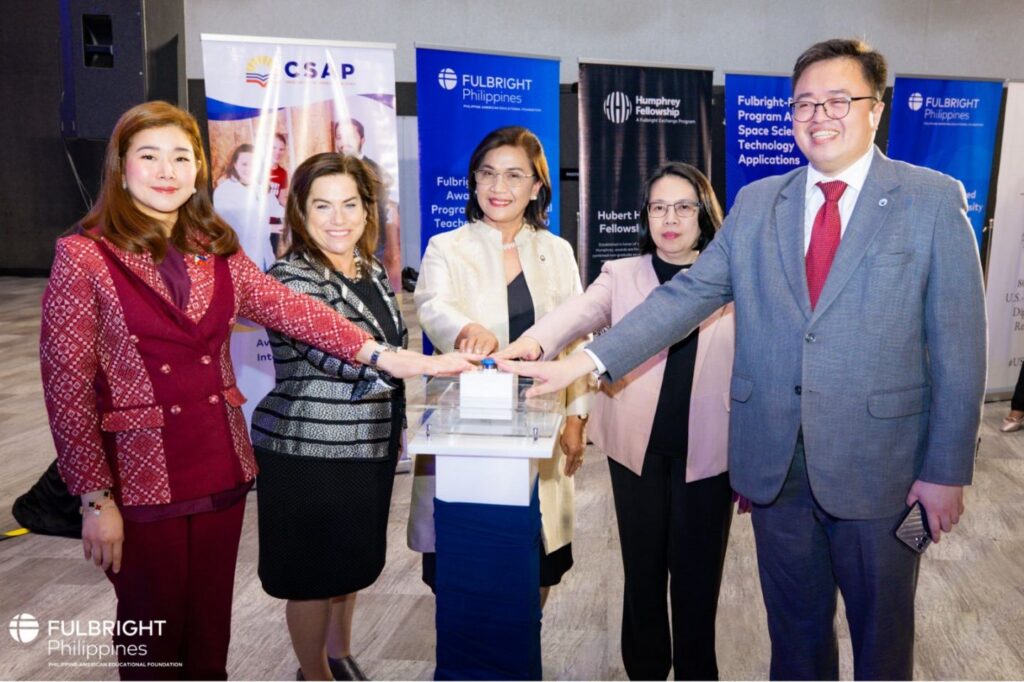
[In photo: (L-R) Department of Tourism Assistant Secretary Christine Joy E. Cari, U.S. Embassy in the Philippines Counselor for Public Affairs Jessica Simon, Commission on Higher Education Chairperson Shirley C. Agrupis, Department of Foreign Affairs Assistant Secretary Raquel Solano, and PAEF Executive Director Julio S. Amador III lead the joint ceremonial button press to officially activate the Consortium for Study Abroad in the Philippines (CSAP) digital portal.]
The Philippines is officially opening its doors to American students seeking academic credit and cultural immersion in Southeast Asia.
The Consortium for Study Abroad in the Philippines (CSAP) was officially launched recently in a high-level ceremony led by the Philippine-American Educational Foundation (Fulbright Philippines), Commission on Higher Education (CHED), Department of Tourism (DOT), Department of Foreign Affairs (DFA), and the U.S. Embassy in the Philippines.
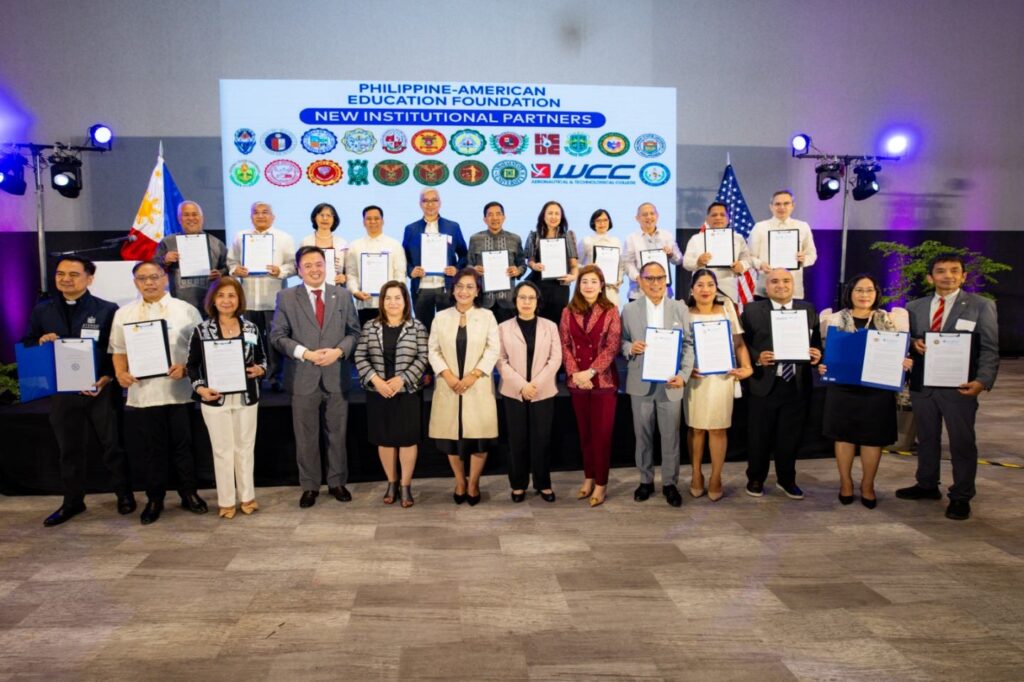
The initiative unites 15 of the country’s top higher education institutions into a streamlined network, creating a direct pipeline for U.S. universities to send students to the Philippines for short-term courses, semester exchanges, and faculty-led programs.
Fulbright Philippines Executive Director July Amador III said, “By providing this structured pathway, we ensure that students and scholars gain not only global-standard academic knowledge but also a deeper appreciation of the cultures and communities that shape our societies.”
U.S. Embassy Counselor for Public Affairs Jessica Simon affirmed the importance of educational exchanges as a cornerstone of the U.S.-Philippines relationship, especially as the two countries celebrate the 80th anniversary of diplomatic relations in 2026. “Today, there is a growing interest among American students to pursue academic and field-based experiences in the Philippines, particularly in marine biology, agriculture, environmental science, and other disciplines.” Simon said.
“Beyond academic growth, at its core, welcoming U.S. students and faculty for cultural exchange and collaborations unite people and cultures. The United States remains committed to deepening our partnership with the Philippines through scholarships and exchanges to empower our people, develop our workforce, and prosper together,” she added.
The launch featured keynote support from CHED Chairperson Shirley Agrupis, who emphasized the importance of the role of CSAP in bringing universities together. “Global education today runs on reliability,” she explained. “Partner institutions need to know that programs are comparable, credits can be transferred, and students will be supported from admission to completion.”
For her part, DOT Assistant Secretary Christine Joy Cari cited the ongoing transformative projects of DOT. “Through flagship programs such as the Voluntourism and the Philippine Experience Program, a cultural immersion initiative showcasing Filipino heritage and gastronomy across multiple regions, we are providing learners and visitors meaningful engagements with our culture and communities,” she noted.
The founding members of CSAP include Ateneo de Davao University, UP Los Baños, UP Visayas, and Silliman University. The consortium offers programs ranging from Marine Biology and Tropical Medicine to Development Studies and Asian Politics.
Established on March 23, 1948, PAEF is a non-profit, binational organization sponsored by then U.S. and Philippine governments. It is the oldest continuously active Fulbright commission in the world and the oldest international scholarship in the Philippines. PAEF has awarded grants to more than 3,000 Filipinos and close to 1,000 Americans to pursue graduate degree study, teaching, and research in the Philippines and the United States.